




Miami Eye & Retina
The premier ophthalmology practice in Miami Beach

Our team is dedicated to providing the finest possible care by utilizing breakthrough advances and techniques in the field of ophthalmology. Miami Eye & Retina has the latest generation cutting edge technology to improve diagnostic precision and improve patient comfort. Our practice prides itself on our modern equipment, operational efficiency, personalized care, and minimal wait times. Daniel Gologorsky, MD, MBA is the Chief of Ophthalmology at Mount Sinai Medical Center in Miami Beach. He is a board-certified Ophthalmologist and fellowship-trained Retina specialist who takes compassionate care of patients with all types of eye disease, including diabetic retinopathy, macular degeneration, glaucoma, cataract, uveitis, and dry eye. Dr. Gologorsky is a published textbook author and prolific academic who has lectured nationally and internationally. An expert of ophthalmic imaging and lasers, Dr. Gologorsky's office has the latest generation cutting edge technology to improve diagnostic precision and improve patient comfort. A native of Miami Beach, ophthalmologist Dr. Gologorsky enjoys Roman history, playing chess, kayaking, and biking.

Expertise

We offer expert medical and surgical treatments for the following conditions:
Annual Eye Exams
Diabetic Retinopathy
Macular Degeneration
Glaucoma
Dry Eye
Cataract

Consulting

A biotech enthusiast and recognized expert in his field, Dr. Gologorsky has extensive background in consulting for both the public and private sectors, and has provided expert opinions in medical-legal cases. His specialities include retina, ophthalmology, operations management, emergency eye care, and maritime healthcare.

Resume

Education & Training

  1. New York Eye & Ear Infirmary

    Fellowship in diseases of the Retina and Vitreous

  2. Bascom Palmer Eye Institute

    Ophthalmology residency. The US News & World Report ranks Bascom Palmer Eye Institute as the #1 Ophthalmology hospital and research center for the 23rd consecutive year.

  3. Dartmouth Medical School (MD)

    Multiple awards for clinical excellence and medical research.

  4. Tuck School of Business at Dartmouth (MBA)

    Focusing on healthcare delivery and operations management.

  5. Cornell University (BA)

    Chemistry & Chemical Biology major. Graduated magna cum laude, Phi Beta Kappa, 4.0 GPA.

Awards

  1. Excellence Award

    American Society of Cataract and Refractive Surgeons Foundation

  2. Payson-Wilson-Hampers MD/MBA Scholar Award

    Tuck School of Business at Dartmouth

  3. Douglas P. Zipes, MD, Award

    Douglas P. Zipes, MD, Award for Excellence in Medical Research

  4. Thomas Brown McClelland Trust Award

    Miami Rotary Club

  5. Campers, Payson, and Wilson Family Award

    Tuck School of Business at Dartmouth

  6. Phi Beta Kappa Society

    Cornell University

  7. Irving Tanner Research Grant

    Cornell University

  8. Pauline and Irving Tanner Dean’s Scholar

    Cornell University. Awarded to top 1% students

  9. Valedictorian

    RASGH Academy

Textbook

Gologorsky D, Rosen RB. Principles of Ocular Imaging

Gologorsky D, Rosen RB.Principles of Ocular Imaging.Thorofare, NJ: SLACK, Inc.; 2021.

Dr. Gologorsky is coauthor of Principles of Ocular Imaging. This textbook is a definitive and comprehensive guide of all current ocular imaging modalities for ophthalmologists, optometrists, and those in training. It provides a concise yet thorough overview of 22 imaging modalities unique to ophthalmology, emphasizing clinical application and replete with illustrative examples and ophthalmic images. This book is used extensively in residency training programs throughout the United States.

Publications

Selected PubMed Medical Manuscripts

  1. 1. Osigian CJ, Gologorsky D, Cavuoto KM, Berrocal A, Villegas V. Oral aceta zolamide as a medical adjuvant to retinal surgery in optic disc pit maculopathy in a pediatric patient. Am J Ophthalmol Case Rep. 2020 Jan 16;17:
  2. 2. Kaplan RI, Drinkwater OJ, Lee RH, Chod RB, Barash A, Giovinazzo JV,Gologorsky D , Jansen ME, Rosen RB, Gentile RC. Pain Control after Intravitreal Injection Using Topical Nepa fenac 3% or Pressure Patching: A Randomized, Placebo-Controlled Trial. Ophthalmol Retina. 2019 Apr
  3. 3. Gologorsky D. Eponymous Dishonor: Kyrielies Plaques. Retina. 2018 Jul;38(7):1261-
  4. 4. Gologorsky D , Rosen R, Lee J. Navigated Retina Laser Therapy (Navilas) as a novel method of laser retinopexy for retinal tears. OSLI-Retina 2018 Nov 1;49(11):e206-e209
  5. 5. Spierer O, Gologorsky D , Adler E, Forster RK. Lamellar keratoplasty with corneoscleral graft for limbal dermoids. Int J Ophthalmol. 2018 Mar 18;11(3):512-
  6. 6. Gologorsky D , Spierer O. Asteroid Hyalosis. Eur J Intern Med, May 2017
  7. 7. Gologorsky D, Williams BK, and Flynn HW Jr. Posterior Pole Retinal Detachment Due to a Macular Hole in a Patient with a Boston Keratoprosthesis. American Journal of Ophthalmology. 2016 April; 5:56-58
  8. 8. Gologorsky D and Flynn HW Jr. Cataract Surgery in the Setting of Severe Pathologic Myopia with High Axial Length: Use of Pars Plana Lensectomy and Vitrectomy. Clin Ophthalmol. 2016 May 27;10:989-
  9. 9. Gologorsky D , Gregori N, Goldhardt R. Dermatologic and Retinal Manifestations of Pseudoxanthoma Elasticum. Br J Dermatol. 2016 Apr;174(4):e21
  10. 10 .Sridhar J, Isom RF, Gologorsky D , Schiffman J, Ajuria L, Huang L , Banta JT. Utilization of Ophthalmology-Specific Emergency Department Services. Semin Ophthalmol. 2016 Sep 6:1- Gologorsky D
  11. 11. Spierer O, Monsalve PF, O’Brien TP, Alfonso EC,Gologorsky D , Miller D. Clinical features, antibiotic
  12. 12. susceptibility profiles, and outcomes of infectious keratitis caused by Achromobacter xylosoxidans. Cornea.2016 May;35(5):626-
  13. 13. Gologorsky D . A Piece of my Mind. On Vision and Perception. JAMA. 2014 Feb 19;311(7):675-6
  14. 14. Gologorsky D , Murray TG. Letter to the editor: immediate implications of improved surgical efficiency. Clin Ophthalmol. 2013;7:2287-8
  15. 15. Gologorsky D , Chang JS, Hess DJ, Berrocal AM. Familial Exudative Vitreoretinopathy in a Premature Child. Ophthalmic Surgery, Lasers & Imaging – Retina. 2013 Nov 1;44(6):603-5
  16. 16. Brodt J, Gologorsky D , Walter S, Pham SM, Gologorsky E. Orbital Compression Syndrome Following Extracorporeal Support. Journal of Cardiac Surgery. 2013 Sep;28(5):522-4
  17. 17. Schefler AC, Gologorsky D , Marr BP, Shields CL, Zeolite I, Abramson DH. Extraocular Metastases of Choroidal Melanoma After Invasive Diagnostic Evaluation. JAMA Ophthalmol. 2013 Sep;131(9):1220-42
  18. 18. Gologorsky D , Greenstein SH. Retrospective Analysis of Second Opinion Patients Self-Referred to Comprehensive Ophthalmology. (Journal of Clinical Ophthalmology. 2013 June. 2013;7:1099 –
  19. 19. Gologorsky D, Jakobiec FA, Freitag S. Transconjunctival Elimination of a Meibomian Keratinous Cyst. Ophthalmic Plastic and Reconstructive Surgery. Ophthalmic Plastic & Reconstructive Surgery. 2012 Dec
  20. 20. Hemmati HD, Gologorsky D , Pineda R. Intraoperative Wavefront Aberrometry in Cataract Surgery. Seminars in Ophthalmology. Seminars in Ophthalmology. 2012 Sep-Nov;27(5-6):100-
  21. 21. Murray TG, Layton AJ, Tong KB, Gittelman M,Gologorsky D , Vigoda M. Transition to a novel advanced integrated vitrectomy platform: Comparison of surgical impact of moving from the Accurus to the Constellation Vision System. Journal of Clinical Ophthalmology. 2013;7:367-
  22. 22. Gologorsky D , Thanos A, Vavvas D. Therapeutic Interventions against Inflammatory and Angiogenic Mediators in Proliferative Diabetic Retinopathy. Mediators of Inflammation. 2012; 2012: 629452
  23. 23. Bekelis K, Desai A, Zhao W, Gibson D, Gologorsky D , Eskey C, Erkmen K. CT angiography: Improving diagnostic yield and cost-effectiveness in the initial evaluation of spontaneous non-subarachnoid intracerebral hemorrhage. Journal of Neurosurgery . 2012 Oct;117(4):761-
  24. 24. Khan S, Finger PT, Yu GP, Razzaq L, Jager MJ, de Keizer RJ, Sandkull P, Seregard S, Gologorsky D , Schefler AC, Murray TG, Kivelä T, Giuliari GP, McGowan H, Simpson ER, Corriveau C, Coupland SE, Damato BE. Angle involvement and glaucoma in patients with biopsy-proven iris melanoma: a response-reply. Archives of Ophthalmology. Archives of Ophthalmology. September 2012;130(9):1229-
  25. 25. Khan S, Finger PT, Yu GP, Razzaq L, Jager MJ, de Keizer RJ, Sandkull P, Seregard S, Gologorsky D , Schefler AC, Murray TG, Kivelä T, Giuliari GP, McGowan H, Simpson ER, Corriveau C, Coupland SE, Damato BE. Clinical and pathologic characteristics of biopsy-proven iris melanoma: a multicenter international study. Archives of Ophthalmology. January 2012;130(1):57-
  26. 26. Gologorsky D , Schefler AC, Williams BK, Dubovy SR, Murray TG. Medulloepithelioma: Invasive versus Noninvasive Diagnostic Methods and their Impacts on Outcome. Retinal Cases and Brief Reports, Winter
  27. 27. Piña Y, Decatur C, Murray TG, Houston SK,Gologorsky D , Cavalcante M, Cavalcante L, Hernandez H, Celdran M, Feuer W, Lampidis T. Advanced retinoblastoma treatment: targeting hypoxia by inhibition of the mammalian target of rapamycin (mTOR) in LH BETA T AG retinal tumors. Journal of Clinical Ophthalmology. March 2011;5:337–
  28. 28. Williams BK, Cebulla CM, Schefler AC, Fernandes CE,Gologorsky D , Murray TG. Required reduction in dose of chemotherapy for retinoblastoma due to Down syndrome-associated chemosensitivity. Retinal Cases and Brief Reports, Winter
  29. 29. Williams BK Jr, Schefler AC, Garonzik SN,Gologorsky D , Shi W, Cavalcante LL, et al. Frequentprosthesis refitting to prevent implant exposure in patients with retinoblastoma. Journal of Pediatric Ophthalmology and Strabismus. 2010;23:1-
  30. 30. Gologorsky D , Schefler AC, Ehlies FJ, Raskauskas PA, Williams BK, Murray TG. Clinical Imaging and High-Resolution Ultrasonography in Melanocytoma Management. Journal of Clinical Ophthalmology. 2010; 4: 855–
  31. 31. Schefler AC, Gologorsky D , Murray TG. Primary Intraocular Lymphoma: An Update on Pathology and Treatments. Retina Today, August
  32. 32. Gologorsky Y, Gologorsky D , Surti U, Yarigina A, MJ Zirwas. Karyotypic and Genetic Abnormalities in Familial Multiple Lipomatosis: A Case Report and Review of the Literature. Cutis. March 2007; 79:227-

Selected Textbook Chapters

  1. 1. Mehta N, Gologorsky D . Fluorescein Angiography" In: Retinal Imaging and Diagnostics. Lee J and Rosen RB (eds). Springer International Publishing Switzerland,
  2. 2. Gologorsky D and Mohsenin A. "Central Retinal Artery Occlusion" In: Manual of Retinal Disease. Medina CA, Townsend JH, Singh AD (eds). Springer International Publishing Switzerland,
  3. 3. Gologorsky D and Mohsenin A. "Branch Retinal Artery Occlusion" In: Manual of Retinal Disease. Medina CA, Townsend JH, Singh AD (eds). Springer International Publishing Switzerland,
  4. 4. Gologorsky D and Mohsenin A. "Cilioretinal Artery Occlusion" In: Manual of Retinal Disease . Medina CA, Townsend JH, Singh AD (eds). Springer International Publishing Switzerland,
  5. 5. Gologorsky D and Mohsenin A. "Idiopathic Juxtafoveal Telangiectasias" In: Manual of Retinal Disease. Medina CA, Townsend JH, Singh AD (eds). Springer International Publishing Switzerland,
  6. 6. Gologorsky D and Mohsenin A. "Ocular Ischemic Syndrome" In: Manual of Retinal Disease . Medina CA, Townsend JH, Singh AD (eds). Springer International Publishing Switzerland,
  7. 7. Gologorsky D and TG Murray . "Enucleation surgery in advanced ocular disease" In: Ocular Melanoma: Advances in Diagnostic and Therapeutic Strategies . Murray TG and H Culver Boldt (eds). 2013
  8. 8. Gologorsky D . "The Cornea. In: Fundamentals of Basic Science and Clinical Medicine. First edition. Providence, RI: Medectomy Publishing;
  9. 9. Gologorsky D . The Lens. In: Fundamentals of Basic Science and Clinical Medicine. First edition. Providence, RI: Medectomy Publishing;
  10. 10. Gologorsky D and AC Schefler. Ocular Oncology. In: Fundamentals of Basic Science and Clinical Medicine. First edition. Providence, RI: Medectomy Publishing;

Pink Eye (Conjunctivitis)

Posted on June 4, 2020

Pink eye, or conjunctivitis, in an eye ailment that manifests with redness, tearing, itchiness, or discharge of the affected eye. It can be highly contagious. In fact, as an undergrad at Cornell, I recall an epidemic of pink eye that caught the attention of the media outlets. The spread of the disease was eventually traced to the main undergrad library, and more specifically, to a set of public computers linked to the common printers.

In this article, I will

  • Explain what conjunctivitis is,
  • Show how to differentiate between different types of conjunctivitis,
  • Describe several standard treatment options, and
  • List some preventative measures you can take to stop its spread.

What is conjunctivitis?

The conjunctiva is a thin translucent film covering the front surface of the eyeball (it covers the "whites of the eyes"). It is a physical barrier that protects the eye from outside pathogens. Like most barrier tissues, the conjunctiva can get infected or inflamed, resulting in conjunctivitis.

Types of Conjunctivitis

There are many types of conjunctivitis, but for clarity, I will divide them into two categories: infectious and allergic. Infectious conjunctivitis can be caused by a virus or by a bacteria. Most of the time (~70-90% of the time), infectious conjunctivitis is caused by a virus.

Determining Conjunctivitis Type
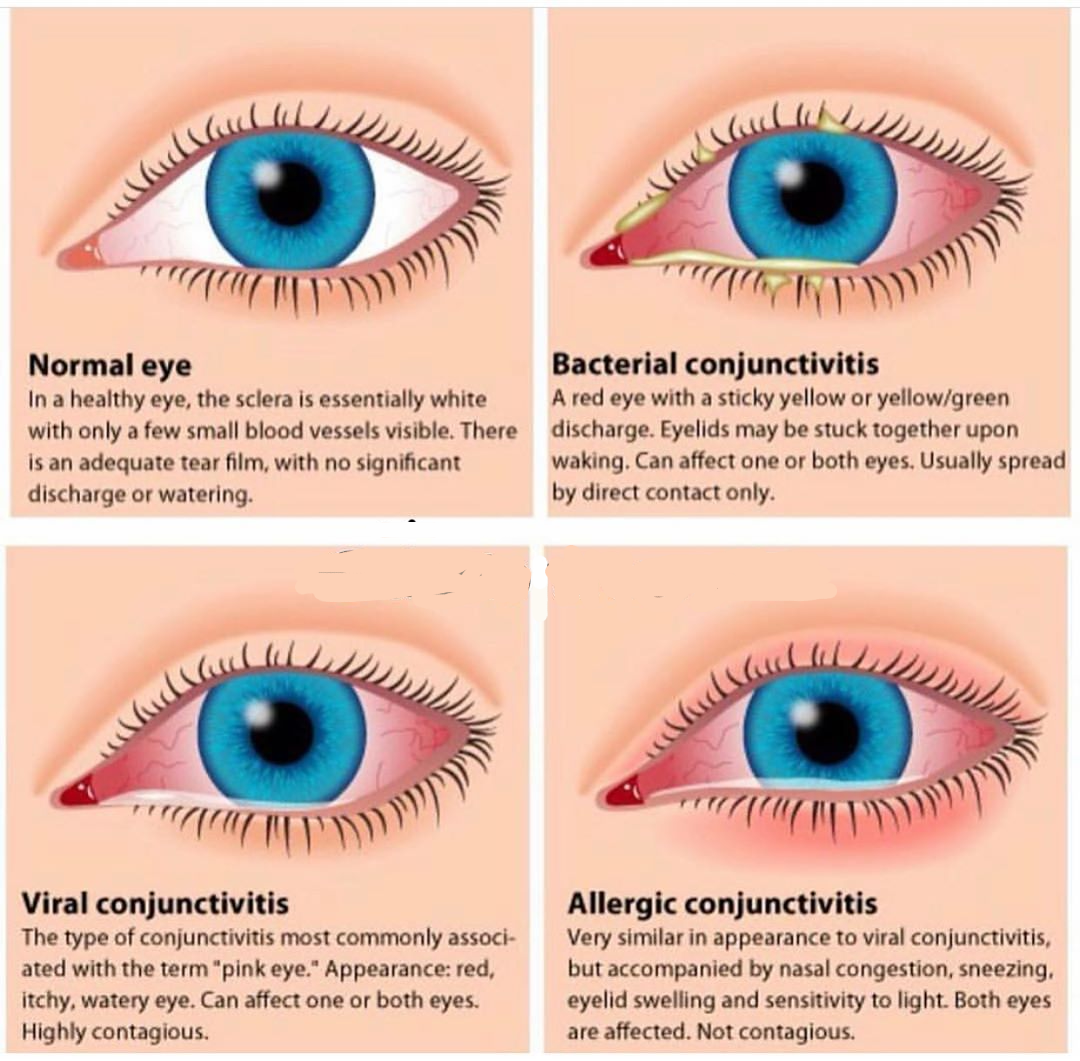
Types of Conjunctivitis

Signs of Viral Conjunctivitis

Viral conjunctivitis is often caused by the same adenovirus that causes an upper-respiratory infection, so a concurrent or recent cold is not uncommon. Viral conjunctivitis is very contagious -- a tell-tale sign of viral conjunctivitis is having the infection spread from one eye to the other, or to other members of the same household or work environment.

Signs of Bacterial Conjunctivitis

While it is difficult to distinguish viral from bacterial conjunctivitis, the latter tends to have heavier colored mucopurulent discharge compared to the former.

Signs of Allergic Conjunctivitis

Allergic conjunctivitis tends to affect those with allergies (pollen, dust), and is more seasonally pronounced. Often this conjunctivitis is associated with a runny nose, spring time, and allergic shiners of the face.

Conjunctivitis Treatment

The treatment of conjunctivitis depends on its underlying cause.

  • Viral conjunctivitis improves only with time (an antibiotic won't work).
    • Exception: in the rare case that the conjunctivitis is caused by the herpes simplex virus, your opthamologist may prescribe an antiviral medication.
  • Bacterial conjunctivitis improves dramatically with antibiotics.
  • Allergic conjunctivitis improves by physically eliminating the allergen and with the administration of antihistamine drops.

Note: There are other treatments for conjunctivitis, including mild steroids and ophthalmic betadine, but such treatments more nuanced and are beyond the scope of this article.

In all cases of conjunctivitis, supportive care with copious artificial tears and cool compresses can make the patient feel better from a comfort perspective. Most of the time, conjunctivitis symptoms resolve on their own within a week.

Prevention Measures

Keep in mind that viral conjunctivitis is highly contagious, so care should be taken to limit physical contact with the affected eye and other people in a social setting. Make sure to:

  • Avoid touching your eye and wash your hands frequently.
  • Frequently change your towels, washcloths, and bedding.
  • Replace any eye cosmetics you have been using, and don't share with others.
  • Avoid swimming pools.

Note: Conjunctivitis is easily spread through contaminated water, so avoid watery settings such as pools, hot tubs, water parks, and lakes. In addition, chlorine and other chemicals in treated water can exacerbate eye irritation.

A comprehensive list of precautionary measures can be found here: CDC Conjunctivitis Prevention

See a Specialist

This article is for educational purposes only and should not be used as a substitute for professional medical advice.

Even among doctors, it is better to see an ophthalmologist for pink eye. Eye specialists are better able to distinguish between the myriad of conditions that can manifest in redness and treat the underlying condition appropriately. While Visine or antibiotic eye drops are commonly prescribed by non-specialists, such treatment may not be appropriate for common viral conjunctivitis. Indeed, a study in the in journal Ophthalmology found that:

"Compared with people seen by an ophthalmologist, those who saw pediatricians, family practice doctors, internists and emergency room doctors were two to three times as likely to receive antibiotics."

So next time you or a friend experiences pink eye, make sure to see an ophthalmologist.

Contact

Contact Form